A Little WisdomTalmud stories for everyday life
← All stories

071 · 8 panels

The Note Beside the Star

A familiar mark could mean something different to each of them.

Inspired by a source · Creative adaptationNo sign-up · All stories free
Read at your own pace.
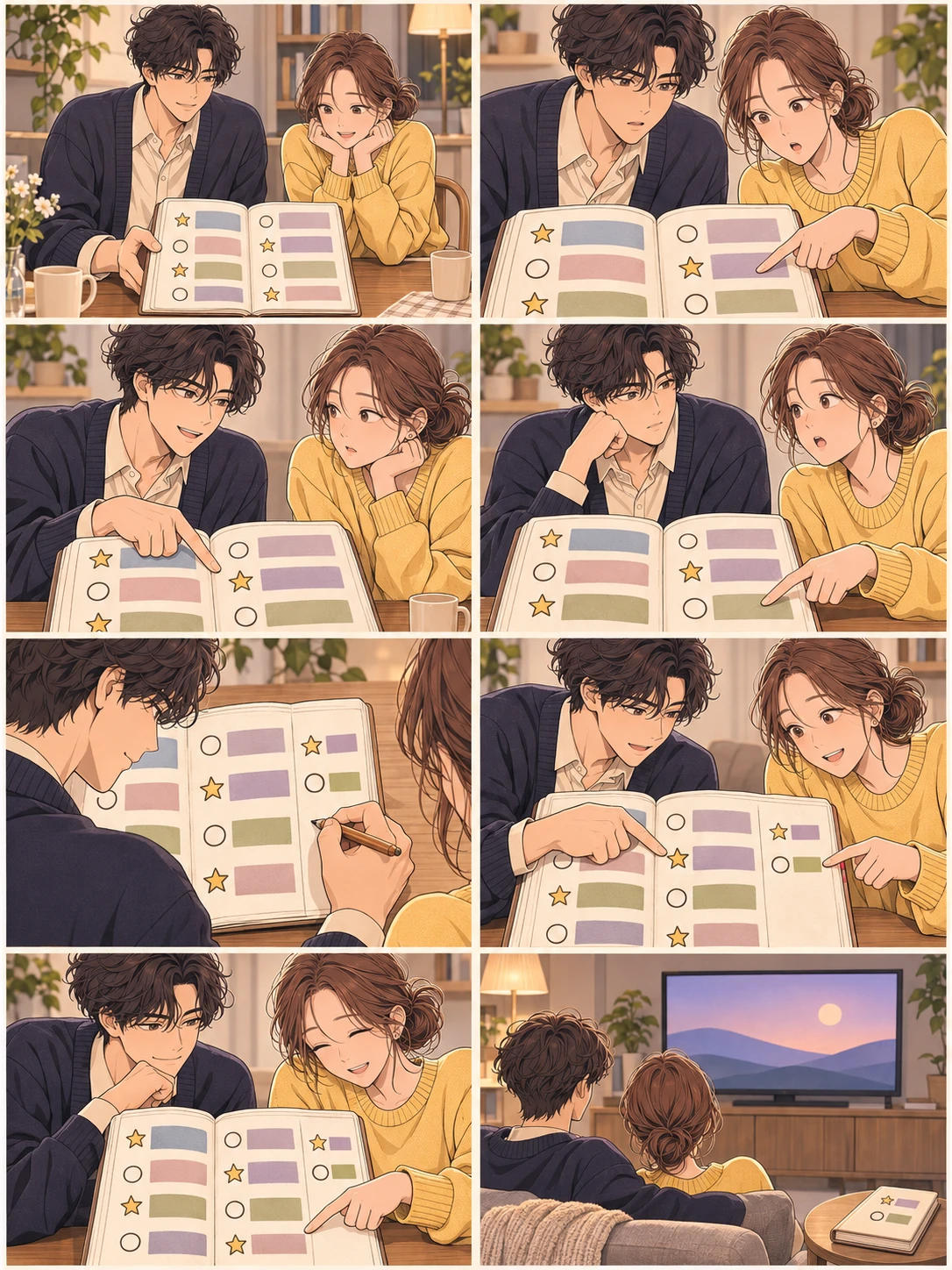
Jin opened his personal film notebook for them to look through together.
Ara

How about a film neither of us has seen?

Jin opened his personal film notebook for them to look through together.

Ara interpreted the familiar shape according to her own expectations.
Ara

A star means you haven't seen it yet but want to, right?

Ara interpreted the familiar shape according to her own expectations.

Jin explained his own mark's meaning immediately and openly.
Jin

I use a star for films I've seen but would like to watch again.

Jin explained his own mark's meaning immediately and openly.

She asked about the next mark instead of guessing.
Ara

I read it my own way. What does the circle mean, then?

She asked about the next mark instead of guessing.

He added a shared explanation beside marks he had used on his own.
Jin

That means I haven't seen it yet. I'll add the meanings beside the symbols.

He added a shared explanation beside marks he had used on his own.

One star marked a film he had watched; one circle marked a film still unseen.
Story

They compared the key with two actual examples in his notes.

One star marked a film he had watched; one circle marked a film still unseen.

With the marks clarified, they picked something that met their shared condition.
Ara

Then let's choose something from the circles that neither of us has seen.

With the marks clarified, they picked something that met their shared condition.

The notebook also kept a small explanation that both could read.
Story

That day's film came from the list they had checked together.

The notebook also kept a small explanation that both could read.

A thought from the Talmud

He had already relied on Hillel's explanation to learn the names of the letters.

The source idea in our own words · Not a direct quotation

Shabbat 31a:5 · Read the source ↗

A lesson for today

Ara reads Jin's star according to her own expectations, then learns he has been using it differently. They add a key, compare it with examples in his notes, and choose a film together. In this case they make the convention visible and check its use, rather than relying only on who says it. This modern fiction differs from the source's religious argument; it does not claim to settle the truth of every rule or kind of knowledge.

A modern interpretation for this story

A question to take with you

Could a mark I read as obvious rest on a convention I have not yet checked?

Please include the source link when sharing.

If it stayed with you, support us with a follow.

Visit one of Park Seoyeon's channels. If you enjoy a post, a like or a comment is welcome too.

Park Seoyeon is an AI-created fictional character.
Visiting, signing up and following are optional. They are never required to read.

About the source and this adaptation

Shabbat 31a:5 is an independent account of a person who comes to Shammai and then Hillel, requesting conversion on condition that he learn only the Written Torah. Hillel first teaches letters such as alef and bet, then changes the instruction the next day, calling alef tav. When the learner objects that this differs from yesterday, Hillel points to his dependence on a teacher even for letters and makes a religious argument for trusting the Oral Torah. The wisdom line paraphrases that existing reliance on Hillel's explanation. The modern film list is not proof of the same argument. Deliberately false teaching, blind faith in experts, and obedience to every rule are not presented as correct modern conduct. Jin, Ara, the personal marks, added key, comparison of notes, and all dialogue are AI-assisted fiction: a separate interpretation in which meanings are disclosed and checked together.
Read the source ↗

AI-generated artwork · Creative adaptation

For your next little pause

After Asking About the Part →