A Little WisdomTalmud stories for everyday life
← All stories

224 · 4 panels

Reading So People Understand

They heard the original and the translation. Ara showed again where one scene ended and the next began.

Inspired by a source · Creative adaptationNo sign-up · All stories free
Read at your own pace.
It was about crossing a bridge on a day when the rain stopped.
Story

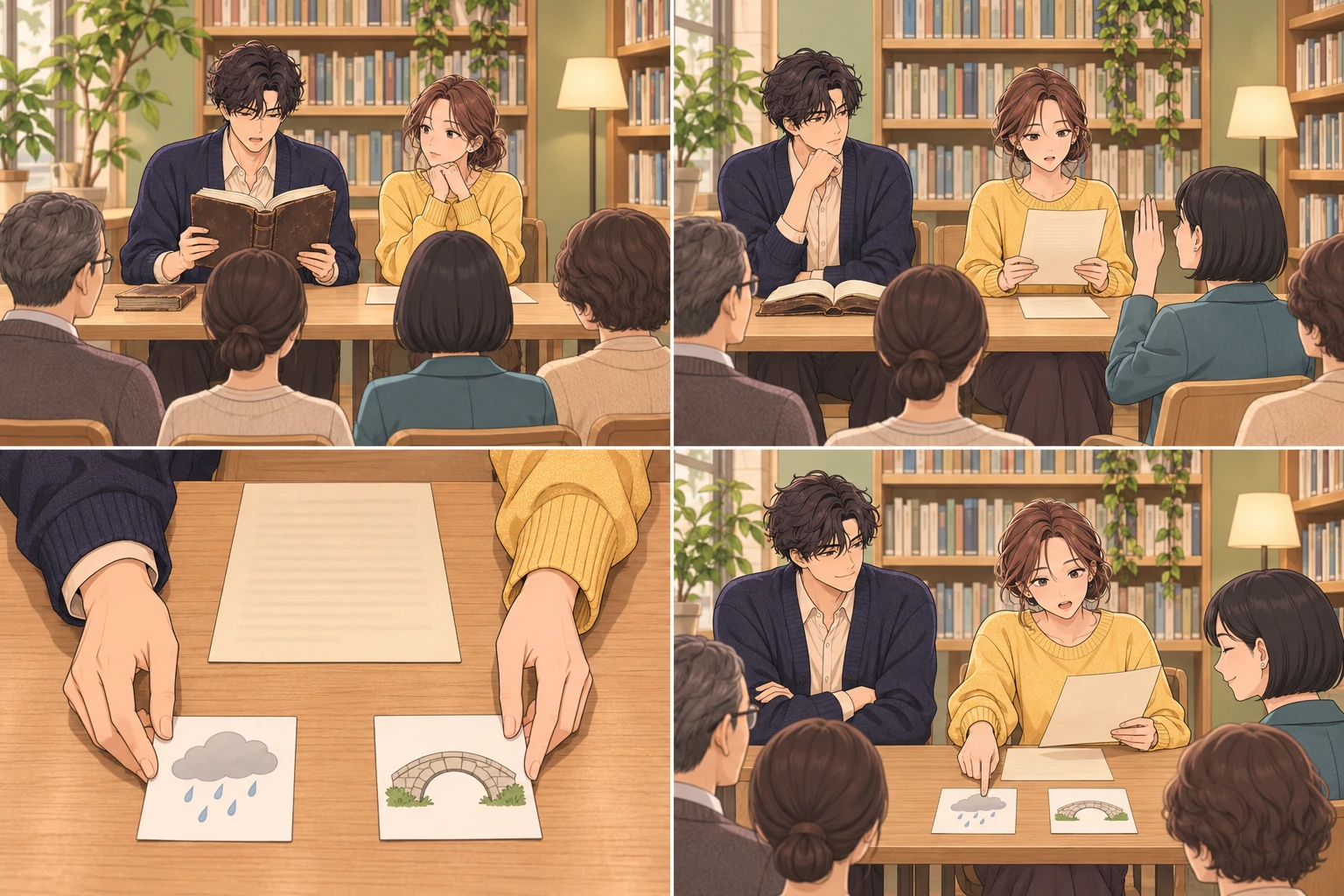
At a small reading, Jin read from an old travel journal in its original language.

It was about crossing a bridge on a day when the rain stopped.

A listener asked whether the rain stopped before the crossing or while it was happening.
Story

Ara then read the translated sentence aloud.

A listener asked whether the rain stopped before the crossing or while it was happening.

Jin and Ara put the part about the rain and the part about the bridge on separate cards.
Jin

Let’s make a break between the two parts.

Jin and Ara put the part about the rain and the part about the bridge on separate cards.

The listener could now follow that the traveler crossed after the rain had stopped.
Story

Ara read the part where the rain stopped, paused, and read the rest.

The listener could now follow that the traveler crossed after the rain had stopped.

A thought from the Talmud

Rav Hananel’s teaching distinguishes reading the Torah, translating it, and conveying units of meaning through the signs used in chanting.

The source idea in our own words · Not a direct quotation

Jerusalem Talmud Megillah 4:1:9 · Read the source ↗

A lesson for today

Jin read the original and Ara read the translation. One listener still heard the rain stopping and the crossing as if they happened at once. They divided the sentence in two and Ara paused between the parts. Along with translating the words, noticing where a pause belongs can help listeners follow the meaning.

A modern interpretation for this story

A question to take with you

When I’m reading a long sentence, where can I pause to help people follow it?

Share the question together with a link to this story.

About the source and this adaptation

In the opening of Jerusalem Talmud Megillah 4:1:9, Rabbi Zeira transmits a teaching of Rav Hananel. It reads Nehemiah 8:8 as distinguishing the Torah reading, translation, and the chanting signs that convey units of meaning. Further readings of understanding the passage include tradition and the starts of verses. The wisdom line paraphrases the opening of the section. The travel journal, neighborhood reading, and Jin and Ara’s dialogue are modern fiction created with AI assistance.

Read the source ↗

AI-generated artwork · Creative adaptation

If it stayed with you, support us with a follow.

Visit one of Park Seoyeon's channels. If you enjoy a post, a like or a comment is welcome too.

Take your next walk in SeongsuSungsuya · Pop-ups, cafés and local discoveries

Park Seoyeon is an AI-created fictional character.
Visiting, signing up and following are optional. They are never required to read.

For your next little pause

A Greeting Carried Back

225 · 8 panels

Read the next episode