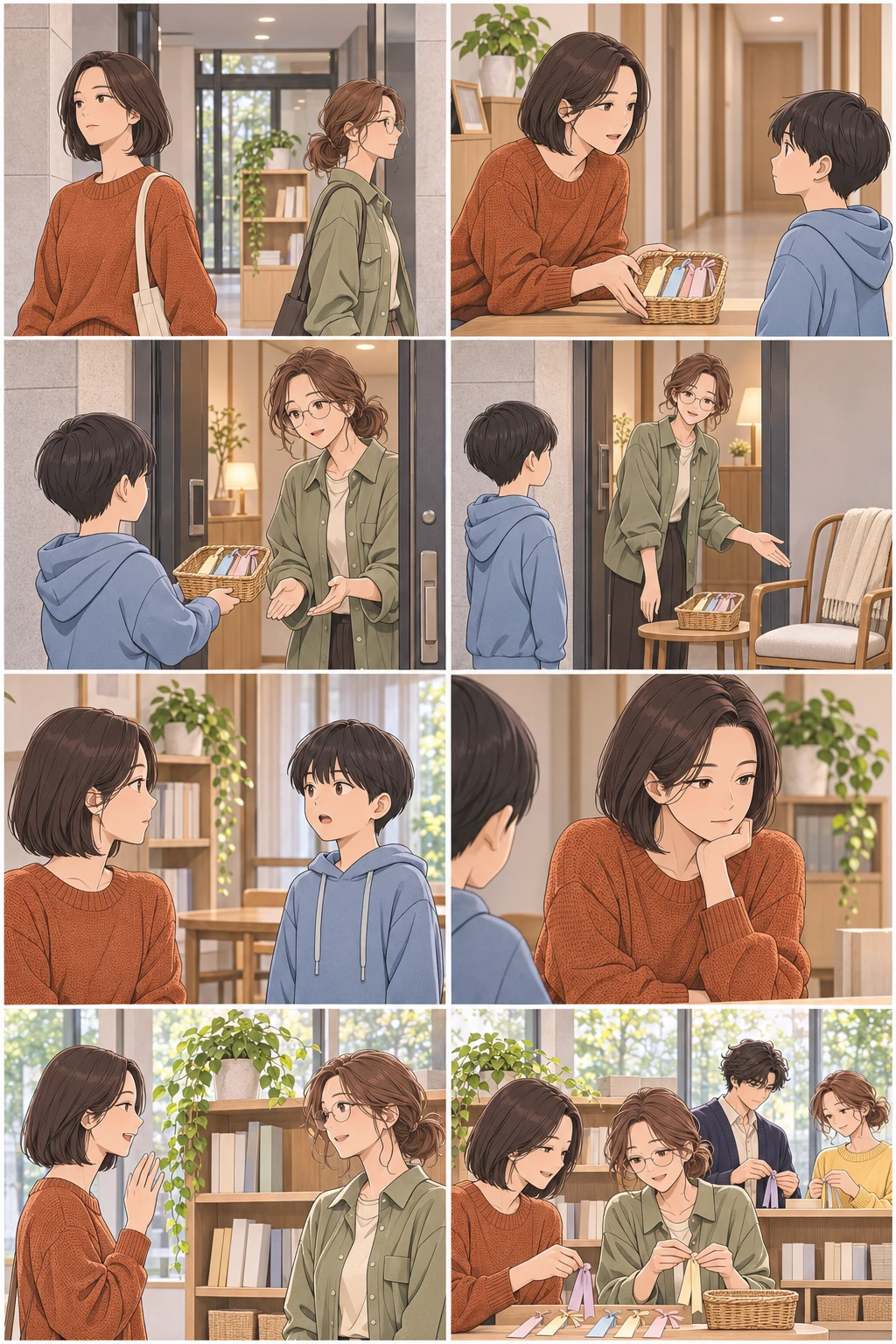
Two neighbors had gone a long time without talking. A child brought home a kind word from next door.
Inspired by a source · Creative adaptationNo sign-up · All stories free
Read at your own pace.
01
Story
Two neighbors passed each other in the shared entrance.
They hadn’t greeted each other for some time.
02
Story
While getting the exchange shelf ready, one neighbor put bookmarks in a basket.
She asked her child if they could take it next door.
03
Story
The child brought the basket next door.
They said it held bookmarks for the exchange shelf.
04
Neighbor
Thanks for bringing it. You can sit for a moment if you’d like.
The neighbor put the basket down and offered the child a chair.
05
Story
Back home, the child repeated what the neighbor had said.
The neighbor had taken the basket and offered a place to rest.
06
Story
The adult paused to think.
She had assumed the neighbor didn’t want to talk to her.
07
Story
The next time, the two neighbors met at the exchange shelf.
This time they greeted each other directly.
08
Story
They laid out the bookmarks on the shelf where Jin and Ara were helping.
This time they asked each other where things should go.
A thought from the Talmud
A woman sent her eruv with her son to a neighbor she was at odds with. When she heard that the neighbor had treated the child warmly, the two adults made peace.
The source idea in our own words · Not a direct quotation
After delivering a basket, the child told the adult at home how the neighbor had offered a seat. The adult had assumed the neighbor didn’t want to talk, but the story made a new greeting feel possible. When the two adults next met, they greeted each other directly. Some of what we take for granted about another person’s feelings is worth checking again.
A modern interpretation for this story
A question to take with you
Have I ever heard about an unexpected gesture and changed my mind about how someone felt?
Share the question together with a link to this story.
About the source and this adaptation
In Jerusalem Talmud Eruvin 7:9:2, Rabbi Yehoshua ben Levi links an eruv, an arrangement that affects how neighbors share a courtyard on Shabbat, with peace. One of two women at odds sends her eruv with her son. After hearing that the other woman embraced and kissed the child, the mother says she hadn’t known the neighbor cared for her, and they make peace. The same story appears in 3:2:4. The wisdom line paraphrases the story. The shared entrance, exchange shelf, basket, and greeting are modern fiction created with AI assistance.