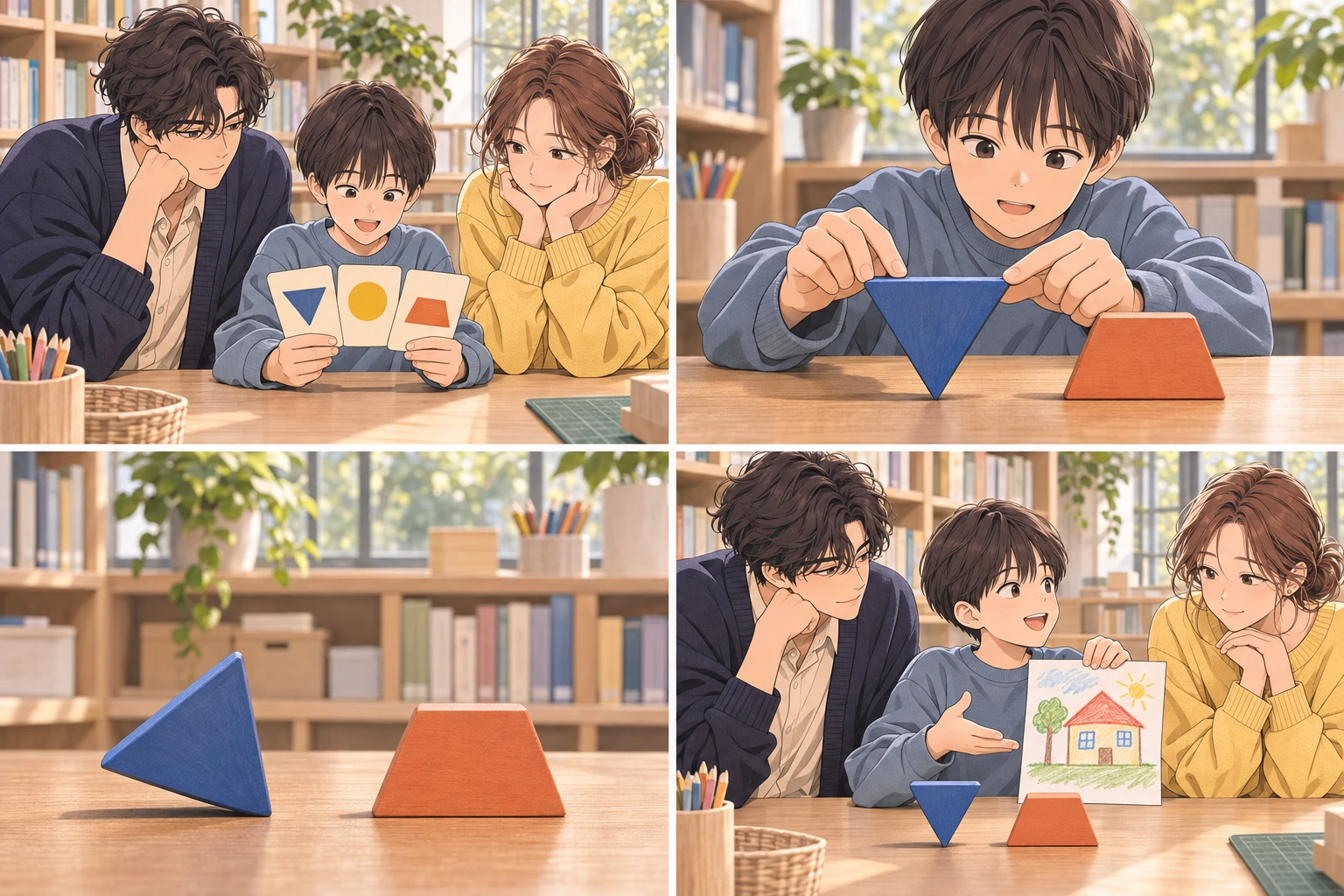
One shape rested on a point. The other had a broad base.
Inspired by a source · Creative adaptationNo sign-up · All stories free
Read at your own pace.
01
Story
At the library’s letter-shape activity, Jin and Ara looked at picture cards with a child.
The shapes on the cards had different bases.
02
Story
The child stood up one shape with a pointed bottom and one with a broad bottom.
Both went side by side on the same table.
03
Story
The pointed shape tilted over.
The one with a broad base stayed upright on the table.
04
Story
The child put their drawing next to the broad shape.
They explained that facts can support what we say the way a base supports a shape.
A thought from the Talmud
The children compared the letters of falsehood to shapes standing on one foot and the letters of truth to shapes with broad bases. That is how they pictured truth standing while falsehood fails to stand.
The source idea in our own words · Not a direct quotation
At the library, the child stood up two shapes with different bases and watched one tilt while the other stayed upright. Jin and Ara looked at the broad base the child had drawn. Before trusting a story for how well it sounds, we can ask what facts support it.
A modern interpretation for this story
A question to take with you
Before I trust a claim, what can I check about the facts holding it up?
Share the question together with a link to this story.
About the source and this adaptation
In the Babylonian Talmud, Shabbat 104a:4–9, young students interpret the shapes and order of Hebrew letters. Section 9 compares sheker (שקר), falsehood, with emet (אמת), truth. It pictures the letters of falsehood as neighbors in the alphabet standing on one foot, and those of truth as spaced farther apart and standing on broad bases. The wisdom line paraphrases the image of the bases. The library’s abstract shapes and the child’s drawing are modern fiction created with AI assistance.