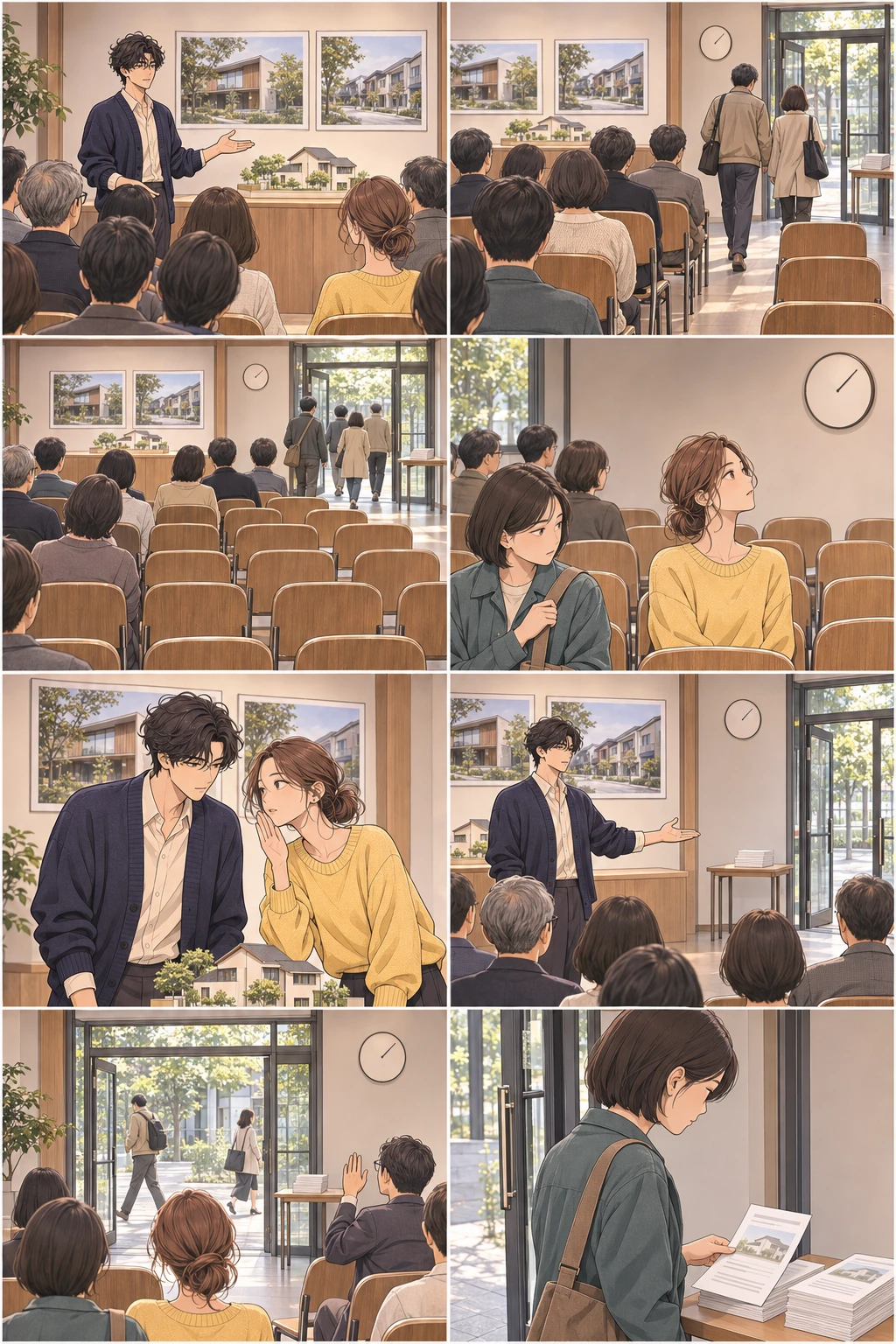
The seats emptied one by one. Someone still sitting wondered if it was all right to get up.
Inspired by a source · Creative adaptationNo sign-up · All stories free
Read at your own pace.
01
Story
On a holiday, Jin gave a talk about local buildings.
He had photographs and a small model in front of him.
02
Story
As the talk went on, a few people got up first.
A couple of chairs were left empty.
03
Story
A little later, other people headed for the door too.
There were more empty seats visible from the front.
04
Story
Someone still in their seat picked up a bag and set it down again.
Ara looked from the empty chairs to the clock.
05
Ara
How about calling a short break? Some people may need to leave early.
Ara approached Jin when he reached the end of a section.
06
Jin
We’ll take a short break here. If you need to leave, please take a summary by the door.
Jin pointed to the small table near the exit.
07
Story
Those who went outside headed off for a meal or to catch their ride.
Those who stayed took a break and then asked questions.
08
Story
There were copies of the summary on the table by the door.
People could take one whether they left early or stayed.
A thought from the Talmud
People left Eliezer’s festival lecture in groups. When those who stayed took his words to heart, he told them he hadn’t been speaking about them. At the end he also urged them to share food.
The source idea in our own words · Not a direct quotation
Jin had been looking at the people who stayed. Then he noticed that those who needed to leave were watching the time too. He and Ara called a short break and put a summary by the exit. People at the same lecture can have different amounts of time. Leaving can be easier when that’s said out loud.
A modern interpretation for this story
A question to take with you
If people at the same event need to leave at different times, how could I let them know what to do?
Share the question together with a link to this story.
About the source and this adaptation
In the Babylonian Talmud, Beitzah 15b:10–13, Rabbi Eliezer teaches festival law all day. Groups leave one after another, and he criticizes those who go. The students who stay are distressed because they think he means them, so he tells them otherwise. At the end he invokes Nehemiah 8:10, calling on them to eat and drink and send portions to people who have nothing prepared. The next section discusses his view of festival enjoyment. The wisdom line paraphrases the reaction of those who stay and his final words. The neighborhood architecture lecture, break, and handout are modern fiction created with AI assistance.