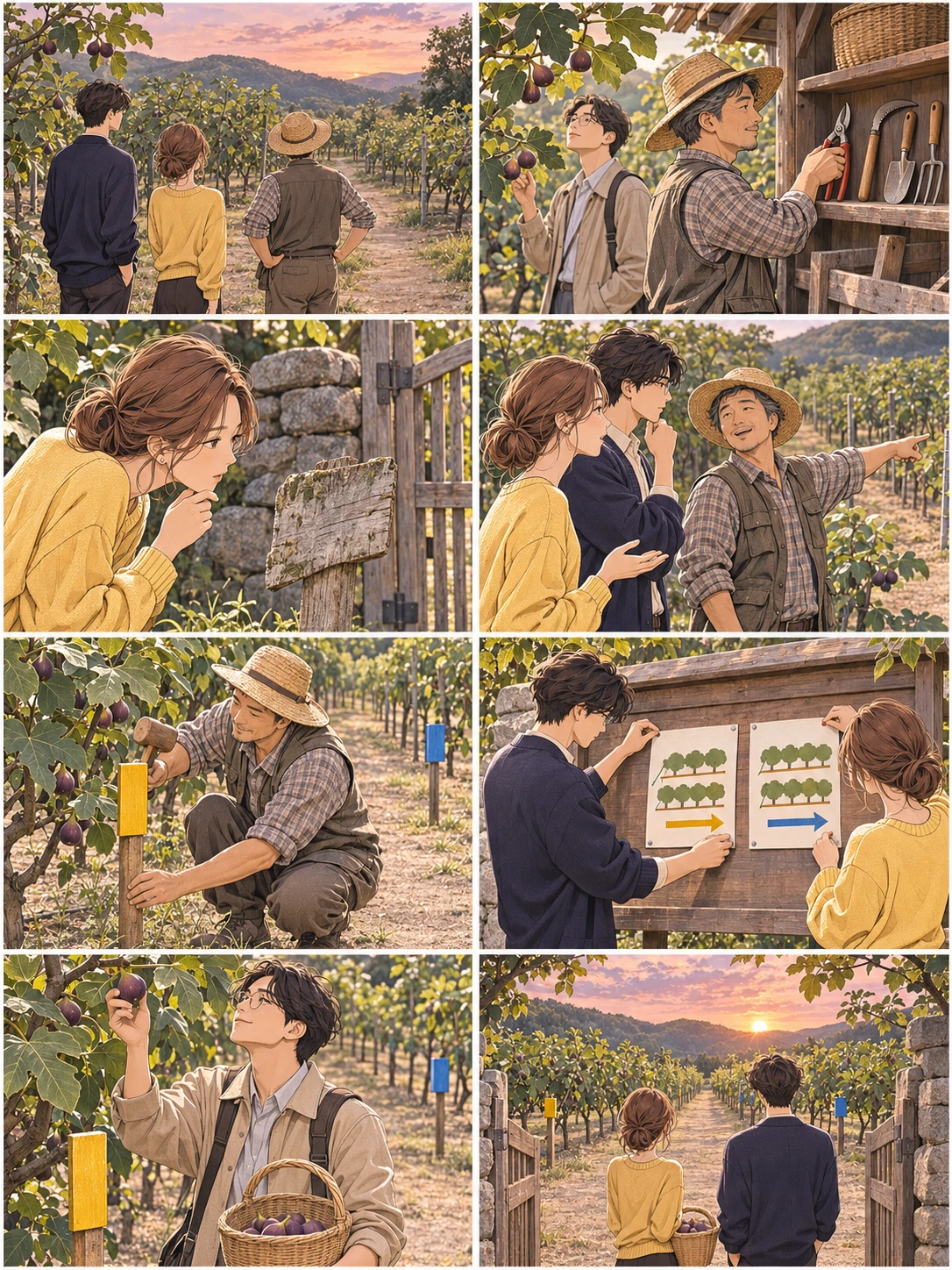
Fruit remained after the tools were put away. Ara first asked which trees they could pick from.
Inspired by a source · Creative adaptationNo sign-up · All stories free
Read at your own pace.
01
Story
Jin and Ara stopped by the neighborhood fig orchard in the evening.
A few trees still had fruit after the harvest.
02
Story
An orchard worker put the day’s tools back on the shelf.
A visitor started to reach for a fig, then stopped.
03
Ara
The entrance sign doesn’t tell us which trees we can pick from.
Ara took another look at the old sign.
04
Story
They asked the orchard owner directly.
The owner pointed to one row of trees along the path.
05
Story
The owner marked the row for neighbors and the row set aside for family.
The two rows had different uses, even in the same orchard.
06
Story
Jin and Ara put up a new sign showing the two areas.
Even someone coming for the first time could see which row was open for picking.
07
Story
The visitor picked only from the trees set aside for sharing.
They put the figs in a small basket.
08
Story
As the sun went down, the three looked at the sign and the basket by the entrance.
The next visitor would be able to see which row to go to.
A thought from the Talmud
Once most of the knives had been put away, Rabbi Hama passed on the teaching that taking the figs left in the field was not theft and that they were exempt from tithes.
The source idea in our own words · Not a direct quotation
The harvest had ended, but that did not mean the neighbors could pick every fig left on the trees. Ara and Jin asked the owner, who showed them the row for sharing and the row reserved for family. The owner marked both, and they put the information at the entrance. When we share a place or its produce, we can make the time, location and limits easy for a first-time visitor to see.
A modern interpretation for this story
A question to take with you
If several people share a place or an object, how can I show a first-time visitor what they may use?
Share the question together with a link to this story.
About the source and this adaptation
In the Babylonian Talmud, Nedarim 62a:3, Rabbi Hama bar Rabbi Hanina eats figs left in a field after most of the knives have been put away. His attendant declines. Hama passes on a teaching he heard from Rabbi Yishmael bar Rabbi Yosei in the name of his father: taking the figs left at that time was not theft, and the figs were exempt from tithes. The wisdom line paraphrases this ruling in the context of the harvest practice discussed there. Segments 2 and 4 contain separate incidents set in the same period. The modern orchard, the owner’s permission and the signs are fiction created with AI assistance.