There were ten cubbies. Counting teams gave two. Counting people gave ten.
Inspired by a source · Creative adaptationNo sign-up · All stories free
Read at your own pace.
01
Story
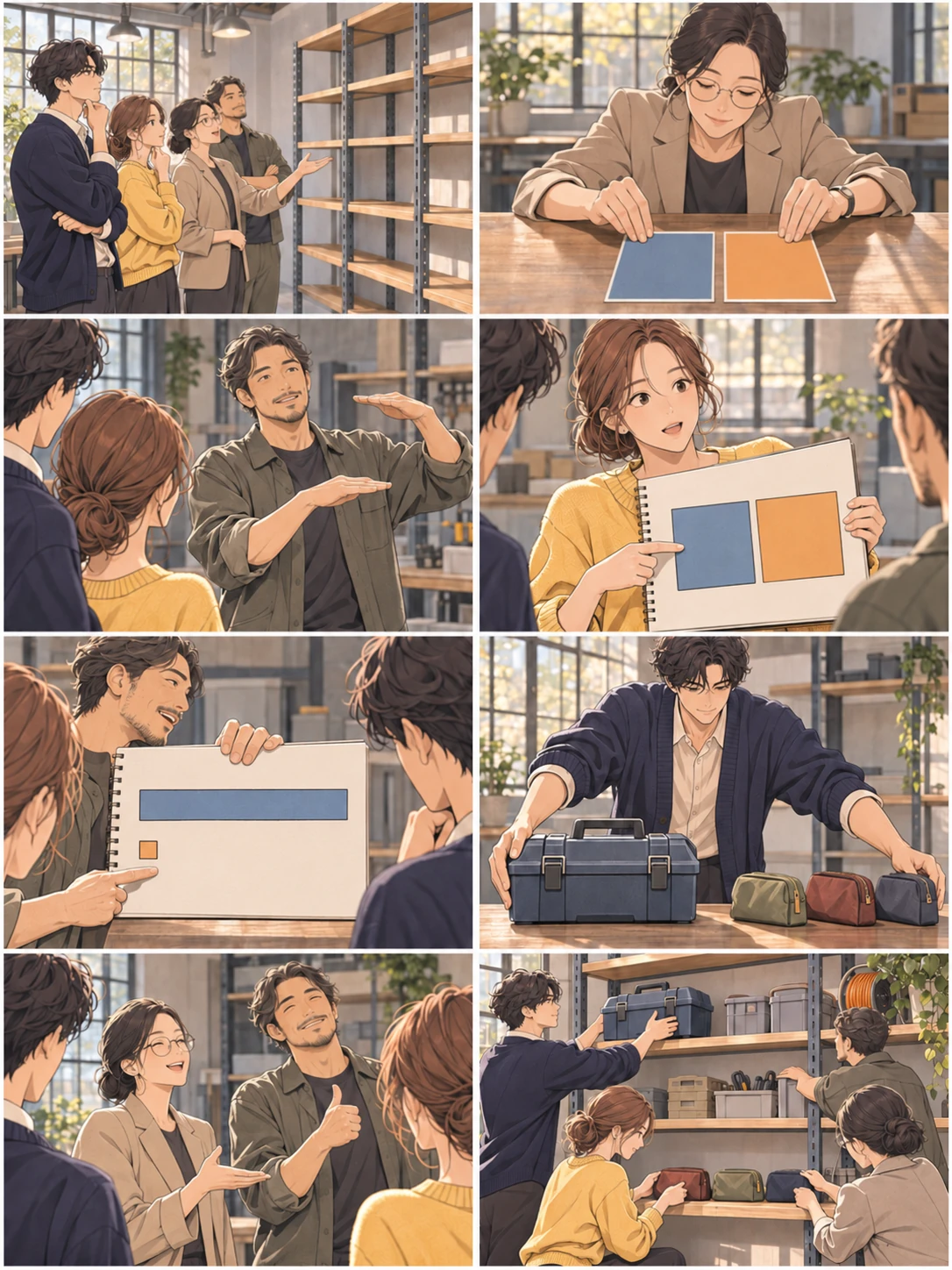
Jin, Ara and two team representatives looked at the empty shelves in their shared workshop.
There were ten cubbies for the two teams to use.
02
Story
One representative suggested giving each team the same share.
They placed two colored cards side by side, one for each team.
03
Story
The other representative said their team had nine people and the other team had one.
They said they needed room for personal belongings, too.
04
Ara
If we split by team, each team gets five of the ten cubbies.
Ara drew two equal sections on a sheet of paper.
05
Ara
One cubby per person gives nine to one team and one to the other.
This time she drew a long section and a short one for comparison.
06
Jin
How about we sort shared equipment from personal belongings first?
Jin set the shared tools and the individual items apart.
07
Story
The representatives agreed to store shared and personal items differently.
They set aside a section for team equipment and counted actual users when making room for personal belongings.
08
Story
The two teams began using the shelves as they'd agreed.
There was one area for shared equipment and another for personal items.
A thought from the Talmud
The shares went back to the two fathers and were divided again. The only son received half, and the nine sons in the other family received the other half together.
The source idea in our own words · Not a direct quotation
The two teams saw the same shelves but pictured different shares. When Ara drew one layout by team and another by person, they could see why they disagreed. They sorted shared equipment from personal belongings and agreed on a way to store each kind. Before comparing the results of a division, it can help to ask what counts as one unit.
A modern interpretation for this story
A question to take with you
When the same things can be divided in different ways, what am I counting as one share?
Share the question together with a link to this story.
About the source and this adaptation
Jerusalem Talmud Bava Batra 8:2:5 illustrates land allotment with a parable about two brothers who left Egypt. One has nine sons and the other has one. The shares go back to the fathers and are divided again. The only son receives half, and the other nine receive the remaining half together. The wisdom line paraphrases the end of the parable. Jin, Ara, the two teams, the shared workshop storage, the team and individual diagrams and the agreement are modern fiction inspired by the parable and created with AI assistance.