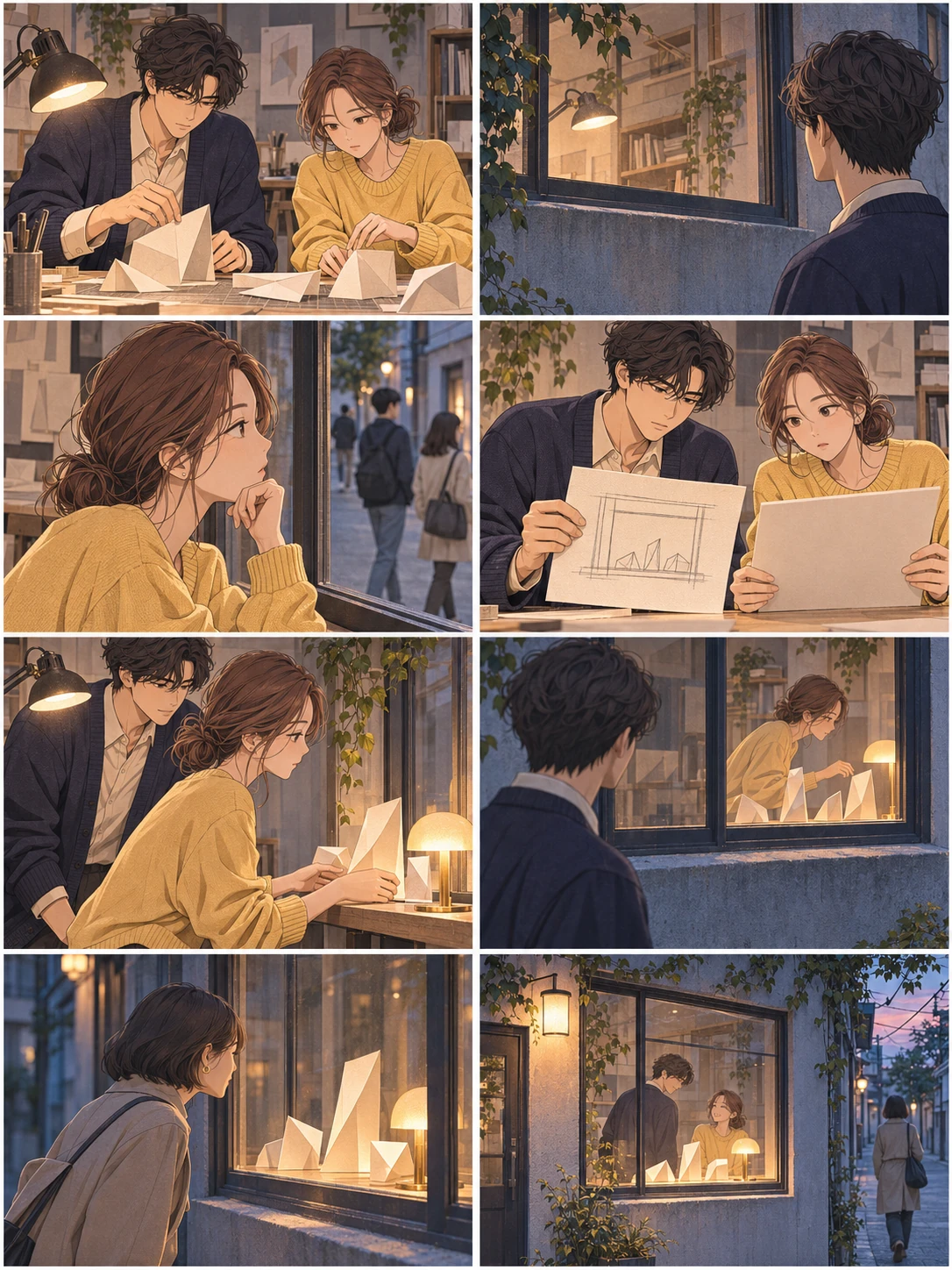
The piece was easy to see inside but hidden from the alley. Jin and Ara made a small place for it by the window.
Inspired by a source · Creative adaptationNo sign-up · All stories free
Read at your own pace.
01
Story
At dusk, Jin and Ara worked on a paper piece in the studio.
The desk lamp made the cut and folded lines easy to see.
02
Story
Jin stepped into the alley and looked through the window.
The piece was on a table below the sill. He could barely see it from outside.
03
Ara
This is where people passing by will see the window.
Ara turned toward the alley and checked the height from which a neighbor was looking.
04
Story
They set a sketch of the window and a small paper model side by side.
They tried to work out how high the piece needed to sit to be seen from the alley.
05
Story
They kept the desk lamp where it was and moved a little display lamp and the piece closer to the window.
One lamp lit their work. The other let people outside see the piece.
06
Jin
I can see the folds in the paper from the alley now.
While Jin checked from outside, Ara shifted the piece a little inside the window.
07
Story
A neighbor passing by stopped in front of the window.
Standing outside, they took a moment to look at the paper piece.
08
Story
The alley grew dark, and the paper piece was still visible in the window.
When they finished work, Jin and Ara looked at the same piece from inside.
A thought from the Talmud
The Temple’s lamps weren’t lit because God needed light. A tradition reads its windows as narrow within and broad without, with the light directed outward.
The source idea in our own words · Not a direct quotation
The paper piece was easy to see under the desk lamp. From the alley it was a different story. Jin and Ara checked the view from outside and made a small display by the window while keeping their work lamp where it was. What’s familiar from inside may look different from outside. When we want to share something, we can consider where the other person will encounter it.
A modern interpretation for this story
A question to take with you
If I’m used to seeing something only from the inside, how could I make it visible to someone outside?
Share the question together with a link to this story.
About the source and this adaptation
In the Babylonian Talmud, Menachot 86b:6–7, Rabbi Zerika transmits Rabbi Elazar’s teaching that God does not need the Temple’s table for eating or the lampstand for light. The following tradition interprets the windows of Solomon’s Temple in 1 Kings 6:4 as narrow on the inside and broad on the outside. The Steinsaltz reading edition explains this as a symbol of light going outward. The wisdom line paraphrases that interpretation. The window display and the scenes with Jin and Ara are modern fiction created with AI assistance.