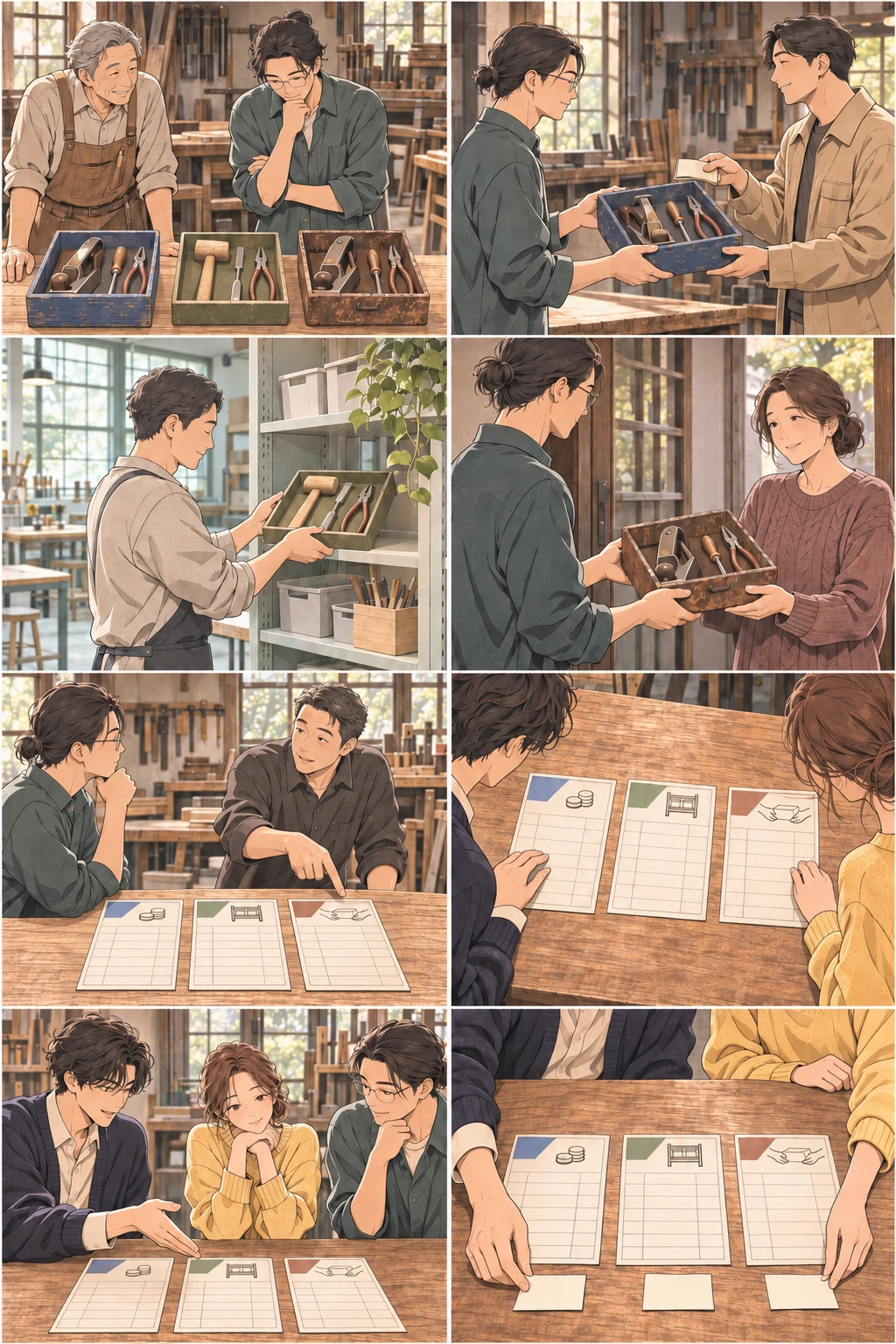
One set was sold, another donated, and the last given back to the donor’s family. Only the last brought a question.
Inspired by a source · Creative adaptationNo sign-up · All stories free
Read at your own pace.
01
Story
Someone clearing a neighborhood workshop gave their hand tools to another worker.
The tools were divided into three sets on a small table.
02
Story
The person who received them sold one set.
A buyer took away a small box.
03
Story
Another set went as a donation to a shared workshop.
Someone who used the space put it on a shelf.
04
Story
The last set went back to the tool giver’s family.
A family member took the old toolbox.
05
Story
Someone who heard what happened asked why the last set had gone to the family.
They didn’t ask about the first two.
06
Ara
Let’s put the three records side by side and see where each set went.
Jin and Ara laid out the record of the sale, the donation, and the return to the family.
07
Jin
For all three, we can ask what the recipient agreed to handle when they first took the tools.
Jin pointed to each of the records in turn.
08
Story
The three people wrote down what they had checked for each set.
They kept the records so it was clear where all three had gone.
A thought from the Talmud
Yonatan sold a third of the property he received, dedicated a third to the Temple, and returned the rest to the giver’s children. When Shammai objected, he asked whether the other two transfers could be reversed on the same grounds.
The source idea in our own words · Not a direct quotation
Someone who hadn’t questioned the sale or donation asked about the tools returned to the family. Jin and Ara laid out three records. They kept the transfers separate and began by asking what the person who received the tools had agreed to take responsibility for. When only one choice feels questionable, we can look at what standard we applied to the other choices too.
A modern interpretation for this story
A question to take with you
If only one of three choices raises a question, what might change if I ask the same question about the others?
Share the question together with a link to this story.
About the source and this adaptation
In the Babylonian Talmud, Bava Batra 133b:12–13, a man who takes issue with his children’s conduct writes a document transferring his property to Yonatan ben Uzziel. Yonatan sells a third, dedicates a third to the Temple, and returns the rest to the man’s children. When Shammai objects, Yonatan asks whether the first two transfers can be undone. The reply continues in 134a:1, where he says that if they cannot be reversed, neither can the transfer to the children. The wisdom line paraphrases sections 12–13. The workshop tools and three records are modern fiction created with AI assistance.