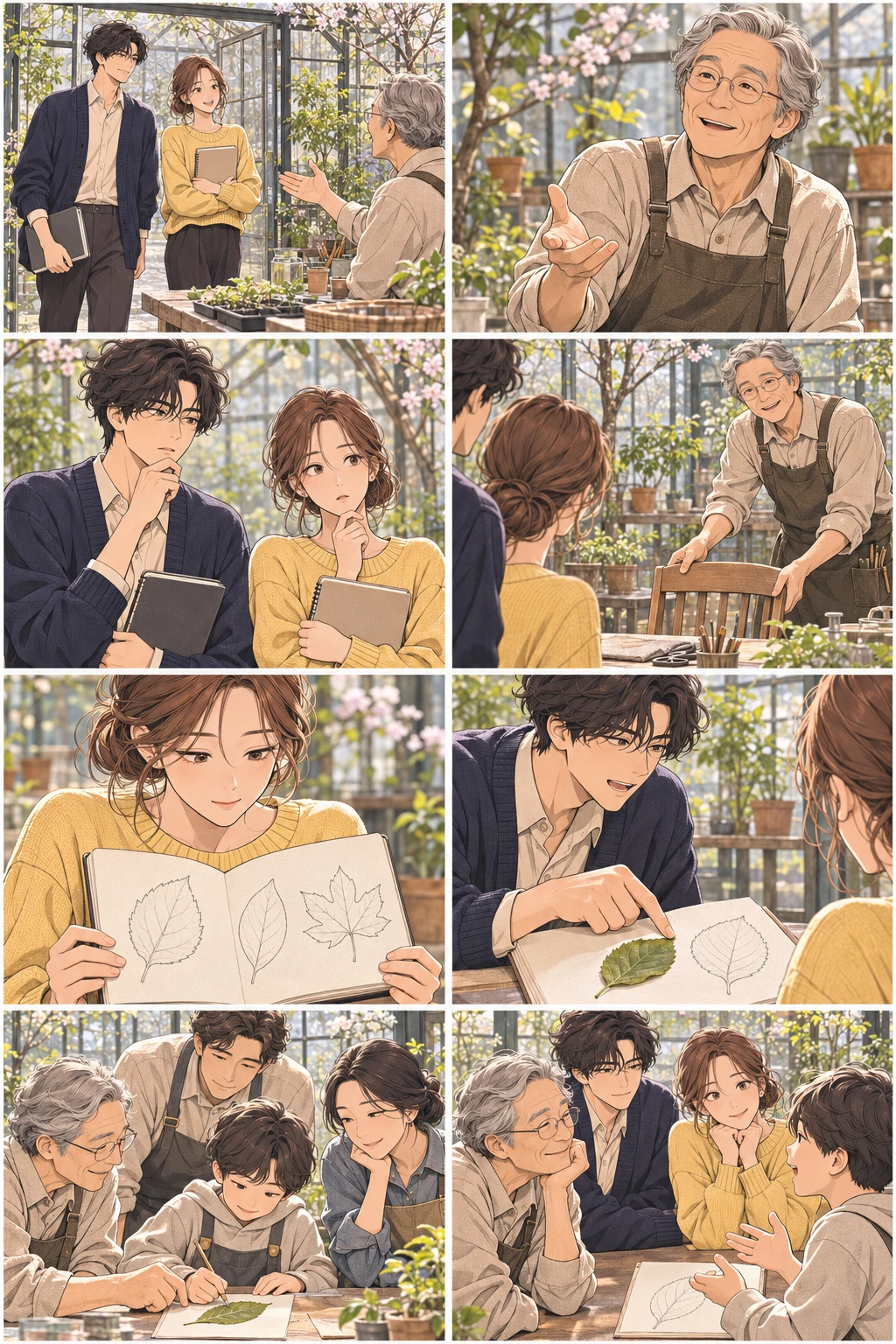
They thought he’d already know. The teacher pulled up chairs and asked what they’d seen that was new.
Inspired by a source · Creative adaptationNo sign-up · All stories free
Read at your own pace.
01
Story
Jin and Ara returned to the little greenhouse after a neighborhood gardening session.
Their gardening teacher was sitting at the worktable.
02
Story
The teacher asked what they had learned that was new.
He was the one who had suggested that they attend.
03
Jin
It might be something you already know.
Jin and Ara hesitated, the closed notebook between them.
04
Story
The teacher pulled up two chairs for them.
He asked who led the session and what they had done.
05
Ara
Even people who’d never come before traced one leaf they liked.
Ara opened her notebook to a page with the outline of a leaf.
06
Jin
Like this. Even without knowing its name, you could say one thing you noticed.
Jin set a real leaf beside the drawing.
07
Story
At the next meeting, the teacher suggested trying the activity.
Children and adults studied the same leaf and drew the parts that caught their eye.
08
Story
A child pointed to the edge of the leaf they’d drawn.
The teacher sat nearby and listened to what the child had seen.
A thought from the Talmud
The teacher asked what had been new at the study hall that day. When the students hesitated, he said a place of study always had something new to hear.
The source idea in our own words · Not a direct quotation
Jin and Ara didn’t think they had anything new to tell their teacher. He made room for them and asked who led the meeting and what people did. That gave them a chance to try the leaf activity at their next meeting, where even first-timers could look closely and say what they saw. Even when we know a subject well, we can learn something by asking what it was like for someone encountering it for the first time.
A modern interpretation for this story
A question to take with you
In a place I know well, how could I ask someone new what stood out to them today?
Share the question together with a link to this story.
About the source and this adaptation
In the Babylonian Talmud, Chagigah 3a:15–17, Rabbi Yohanan ben Beroka and Rabbi Elazar ben Hisma visit Rabbi Yehoshua in Peki’in. He asks what they learned in the study hall that day. When they hesitate, he asks who taught and what the topic was. They report that Rabbi Elazar ben Azariah interpreted the Hakhel assembly in Deuteronomy 31:12, explaining that young children are brought so those who bring them may be rewarded. Rabbi Yehoshua likens the teaching to a precious pearl. The wisdom line paraphrases his opening question. The greenhouse and leaf drawing are modern fiction created with AI assistance.