A Little WisdomTalmud stories for everyday life
← All stories

022 · 8 panels

The Question I Couldn't Answer

Even the person who called it easy met a question he could not answer.

Inspired by a source · Creative adaptationNo sign-up · All stories free
Read at your own pace.
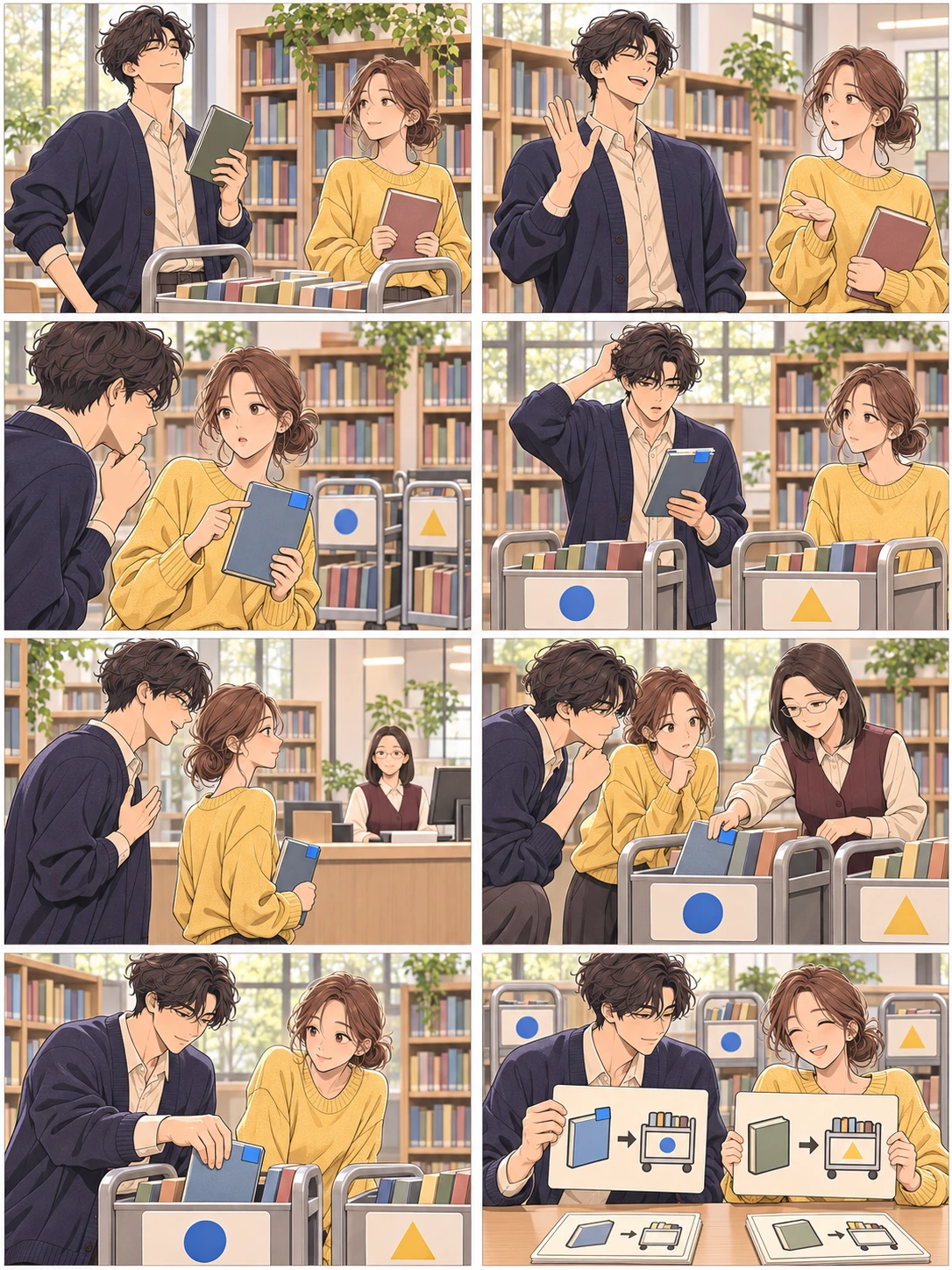
They were beginning an afternoon of volunteering at a small library.
Jin

I'm getting pretty familiar with sorting the books now.

They were beginning an afternoon of volunteering at a small library.

He treated Ara's question about where to put a book as too easy.
Jin

We learned that last time, didn't we?

He treated Ara's question about where to put a book as too easy.

She asked about a different case.
Ara

Then does a returned book with a reservation go on the same shelf?

She asked about a different case.

He did not fill the gap by pretending to know.
Jin

That… I heard it before, but I can't remember clearly.

He did not fill the gap by pretending to know.

He first put right the words that had pushed the question away.
Jin

Sorry I dismissed your question. Let's check with the staff together.

He first put right the words that had pushed the question away.

The staff member demonstrated the actual sorting process.
Receptionist

Here, we put reserved returned books on this separate cart.

The staff member demonstrated the actual sorting process.

Listening and watching helped him confirm what he had learned.
Jin

Right. We keep them separate so the people waiting can be notified first.

Listening and watching helped him confirm what he had learned.

After saying he knew, he made room to learn again.
Story

Together, they added what they had checked to the guide for the next volunteers.

After saying he knew, he made room to learn again.

A thought from the Talmud

Even when teaching, acknowledge what you do not know and stay willing to learn again.

The source idea in our own words · Not a direct quotation

Pesachim 66a:6–8 · Read the source ↗

A lesson for today

Knowing a familiar task does not mean knowing every case. If you belittled a question, put that right; when your memory is uncertain, check with responsible staff or documentation. Keeping what you confirm together can help the next person learn, too.

A modern interpretation for this story

A question to take with you

Before dismissing someone's question as easy, what should I check for myself?

Please include the source link when sharing.

If it stayed with you, support us with a follow.

Visit one of Park Seoyeon's channels. If you enjoy a post, a like or a comment is welcome too.

Park Seoyeon is an AI-created fictional character.
Visiting, signing up and following are optional. They are never required to read.

About the source and this adaptation

In the discussion of sacrifice and Shabbat law in Pesachim 66a:6–8, Hillel rebukes others but then admits that he has forgotten a rule he learned. After observing people's actions, he recalls the teaching received from his teachers. This modern library-volunteer story draws on admitting uncertainty and checking while learning. Jin, Ara, the staff member, the sorting procedure, the apology, the guide cards and all dialogue are fictional.
Read the source ↗

AI-generated artwork · Creative adaptation

For your next little pause

The Same Map, New Paths →