One always seemed busy. The other rarely spoke. The neighbors heard what each had offered.
Inspired by a source · Creative adaptationNo sign-up · All stories free
Read at your own pace.
01
Story
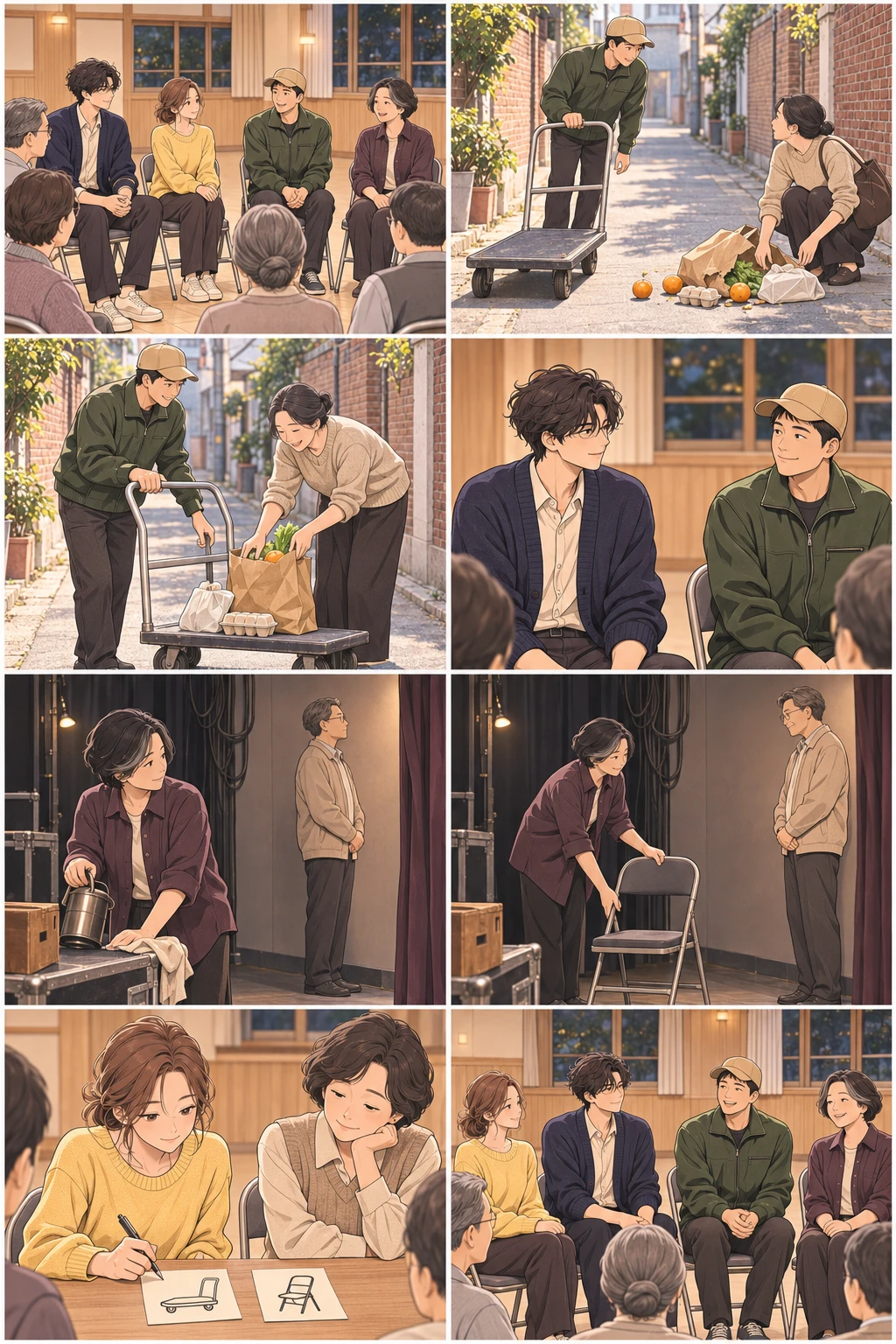
Neighbors met at the community hall to share stories of helping one another.
Jin and Ara heard about a delivery worker who always seemed busy and a stage worker who rarely spoke.
02
Story
One day the delivery worker was passing through the alley.
Someone’s paper shopping bag tore and their things fell out.
03
Story
The delivery worker lent them the cart they’d been pulling.
Once the things were back together, the person could take them the rest of the way.
04
Story
Listening in the hall, Jin looked at the delivery worker again.
He hadn’t known about it from seeing them pass by.
05
Story
On another day, the stage worker was tidying the waiting area behind the theater.
A visitor had been standing there a long time with nowhere to sit.
06
Story
The stage worker brought over the folding chair they had been using.
They quietly opened it next to the visitor.
07
Ara
One person offered a cart. The other offered a chair.
Ara and a neighbor wrote the two scenes down side by side.
08
Story
The neighbors looked over at the two workers in the hall.
They could picture two things they hadn’t seen before.
A thought from the Talmud
Those looking for someone to pray for rain asked a donkey driver and Pantokaka what good deed they had done. Each told of selling something of his own to help someone in trouble.
The source idea in our own words · Not a direct quotation
The delivery worker lent out a cart even while busy. The stage worker quietly offered the chair they had been using. Jin and Ara heard those stories with neighbors who thought they knew the two workers already. Before we assume a familiar impression tells the whole story, we can listen for what we never saw.
A modern interpretation for this story
A question to take with you
What might I not know about a person I remember in only one way?
Share the question together with a link to this story.
About the source and this adaptation
In Jerusalem Talmud Taanit 1:4:5–6, a donkey driver and a theater worker named Pantokaka are separately singled out to pray for rain. Each describes helping a woman trying to free her imprisoned husband. The driver sells his donkey, and Pantokaka sells his bed and bedcover, and each gives her the proceeds. The two accounts end by saying their prayers are worthy of being heard. The wisdom line paraphrases the two episodes together. The delivery worker, stage worker, cart, and chair are modern fiction created with AI assistance.