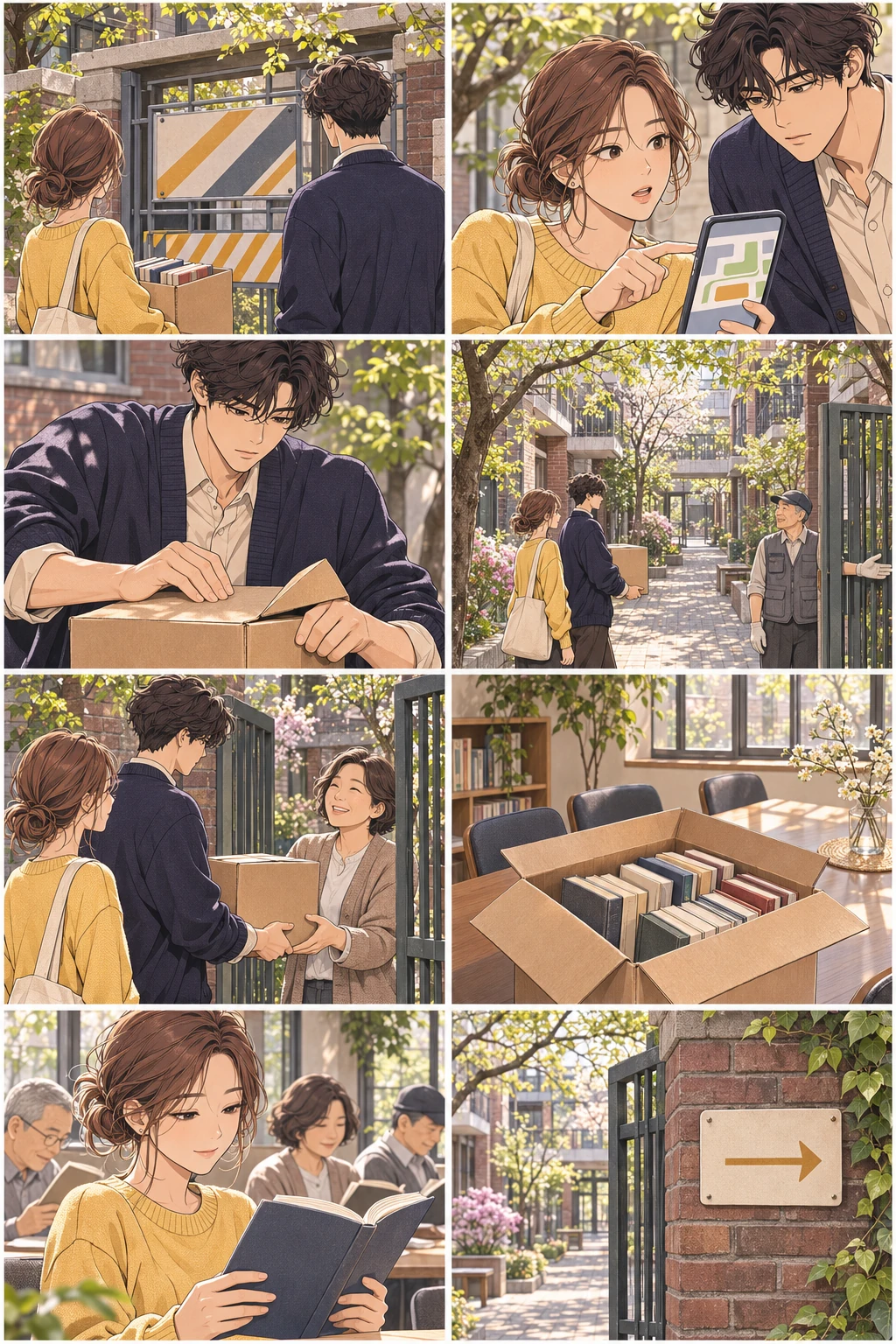
Street work closed the reading room. The neighbors moved the books through courtyards they had permission to use.
Inspired by a source · Creative adaptationNo sign-up · All stories free
Read at your own pace.
01
Story
Street work closed the neighborhood reading room for the day.
A notice about the work was posted at the usual entrance.
02
Story
Ara saw the reading group waiting at a shelter down the lane.
They’d heard that a nearby community room was available.
03
Jin
I’ve put the books we’re lending out in this box.
Jin closed the box to keep the books from shifting.
04
Story
The neighbors looked for a way around the construction area.
They got permission from the people in charge to use the connected shared courtyards.
05
Story
At the gate to the first courtyard, Jin handed over the box.
A neighbor who was waiting there took it with both hands.
06
Story
The neighbor crossed the connected courtyards and walked to the nearby meeting room.
The books made it to the room inside the same box.
07
Story
Children and adults sat down in the room and opened their books.
Someone who’d arrived early picked a page they hadn’t read yet.
08
Story
They also marked a route for anyone returning books.
Small signs showed the way to the next courtyard.
A thought from the Talmud
In a time of danger, they carried a Torah scroll from a courtyard to a roof, down to a courtyard again, and on to an enclosure where they could read it.
The source idea in our own words · Not a direct quotation
The reading room was closed, but there was a place to read in a nearby community room. The neighbors stayed out of the construction area and passed the books through courtyards they had permission to use. Two people carried the same box in turn, and the group could meet again. When a familiar place is unavailable, we can look for another place to gather and a route that will get us there.
A modern interpretation for this story
A question to take with you
If a familiar place becomes unavailable, where could we find another place to keep doing something together, and how could we get there?
Share the question together with a link to this story.
About the source and this adaptation
In the Babylonian Talmud, Eruvin 91a:4, Rabbi Yehuda recalls that during a time of danger they carried a Torah scroll from a courtyard to a roof, down to a courtyard again, and on to an enclosure to read it. The Steinsaltz reading edition explains this danger as a time when decrees banned religious observance. In segment 5 the sages say an incident in a time of danger is no basis for the usual Shabbat carrying rules. The wisdom line paraphrases the route in segment 4. The temporary closure for street work and the scenes with the neighbors are modern fiction created with AI assistance.