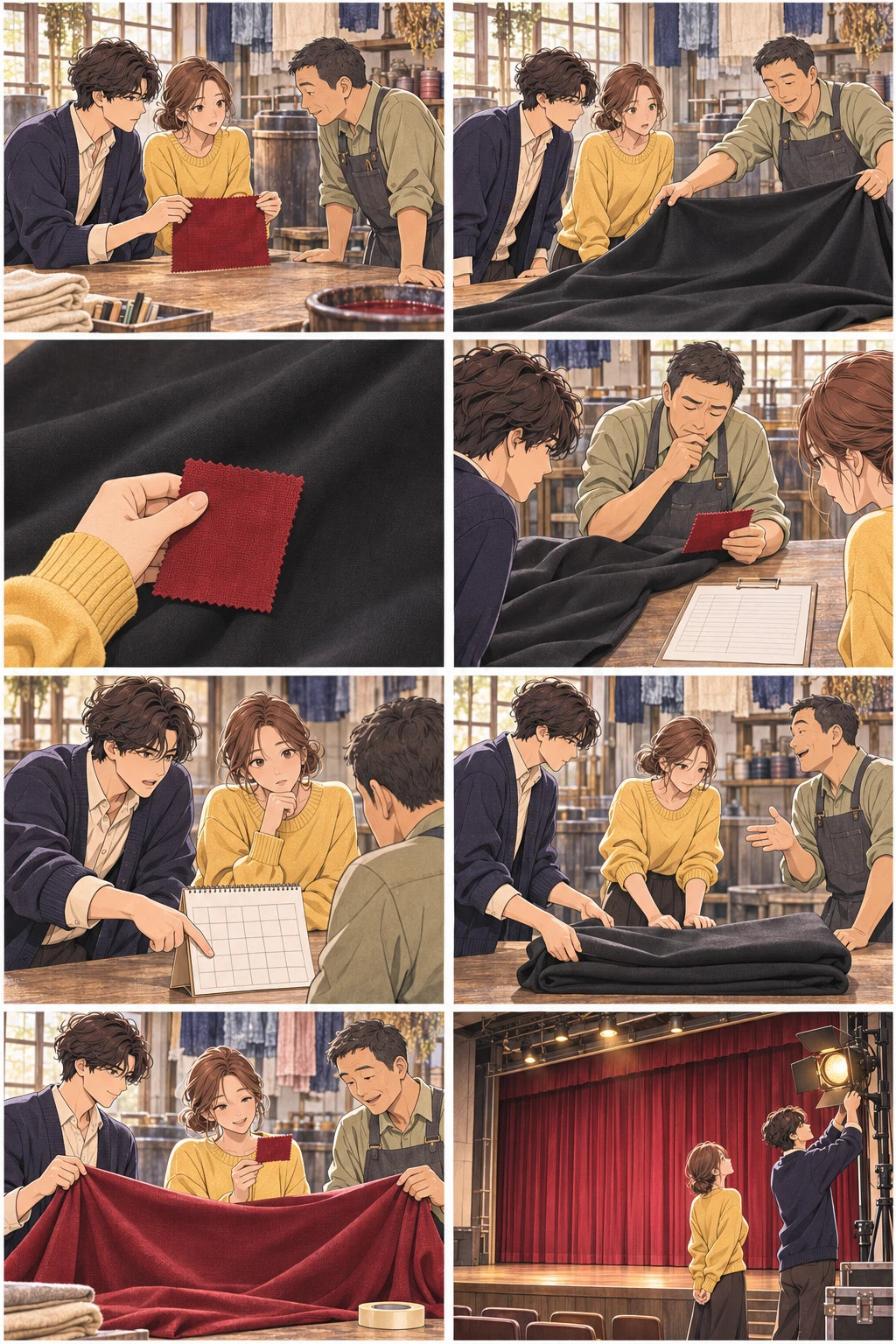
They laid the black fabric beside the red swatch. Then they checked what the show actually needed.
Inspired by a source · Creative adaptationNo sign-up · All stories free
Read at your own pace.
01
Story
Jin and Ara unfolded a red swatch at the dye workshop.
They used it to order the color for a curtain for the neighborhood show.
02
Story
The dyer unfolded the finished fabric.
They’d been expecting red. The cloth on the table was black.
03
Ara
This is the color we chose. Could we look at them together?
Ara held the red swatch beside the black fabric.
04
Story
The dyer checked the order against both fabrics.
They acknowledged that they had dyed it a different color from the one ordered.
05
Jin
The show is on this day. We need a red curtain in this size.
Jin opened the schedule and pointed to the date.
06
Story
The three folded the black fabric separately and agreed on a new date.
The workshop would provide new fabric and finish the order at the price they had first agreed.
07
Story
The workshop got in touch again.
The three unfolded the new red fabric and checked it against the swatch and the measurements.
08
Story
On the day of the show, the red curtain hung across the stage.
Before it began, Jin and Ara checked the lights behind the curtain.
A thought from the Talmud
When wool ordered red was dyed black, Rabbi Meir said the dyer should pay the owner its original value. Rabbi Yehuda weighed the lower of the expenses and the added value.
The source idea in our own words · Not a direct quotation
The black cloth could have a use, but Jin and Ara had ordered a red curtain for this show. The group checked the swatch against the order and discussed whether they could remake it in time. When work turns out differently from what we agreed, we can ask separately whether it’s usable and whether the original task was done.
A modern interpretation for this story
A question to take with you
If I receive a result that differs from what we agreed, how can I explain what changed and what I still need?
Share the question together with a link to this story.
About the source and this adaptation
The Mishnah in the Babylonian Talmud, Bava Kamma 100b:2–3, distinguishes wool destroyed in the vat, uneven dyeing and dyeing in the opposite color from the one ordered. In segment 3, Rabbi Meir says the dyer pays the owner the original value of the wool. Rabbi Yehuda says the owner pays the dyer the lesser of the work expenses and the increase in value from dyeing. The wisdom line paraphrases the two views in segment 3. The stage curtain and workshop agreement are modern fiction created with AI assistance.