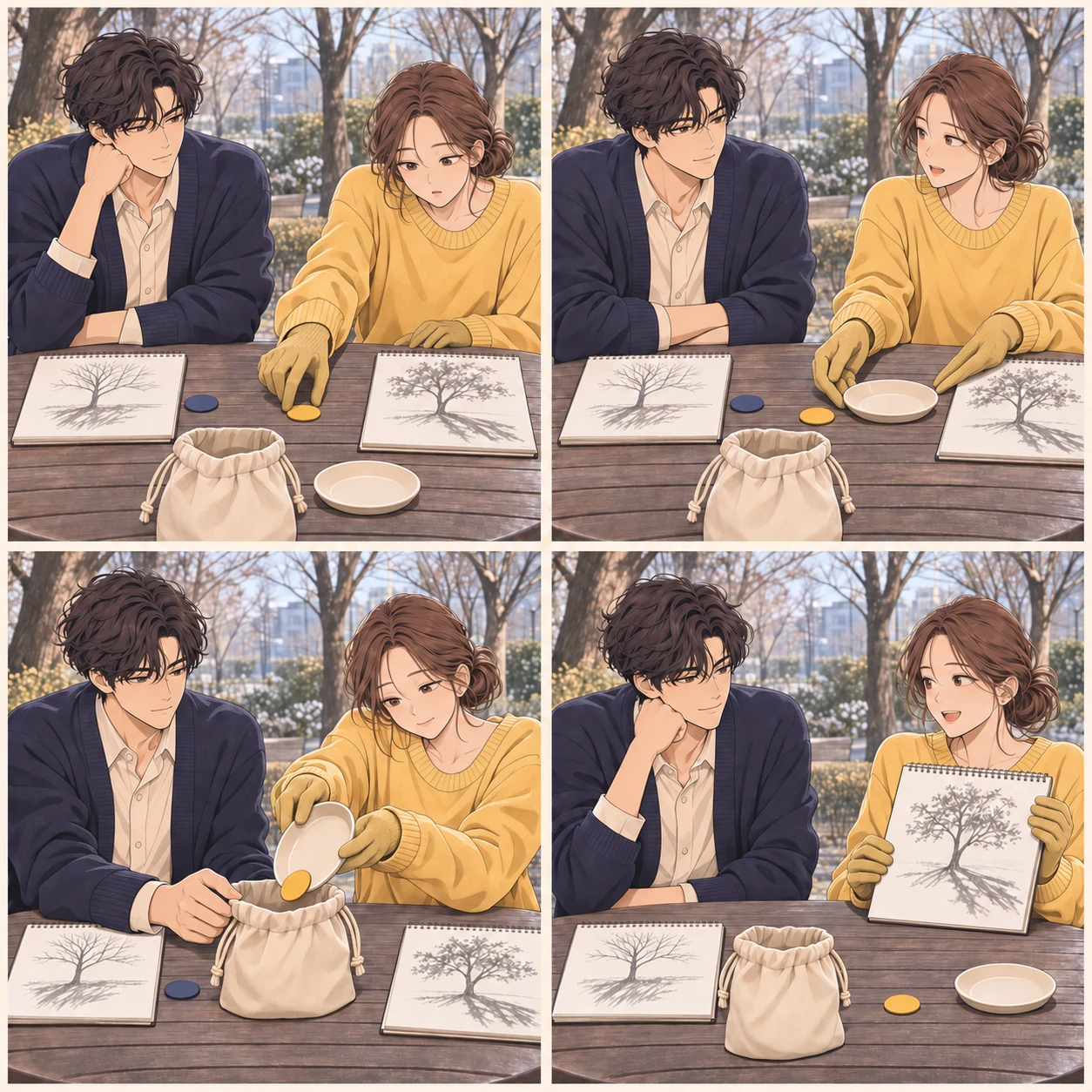
The two wanted to draw lots to decide whose sketch to discuss first. With her gloves on, Ara found the thin token hard to pick up and proposed using a small saucer to put it in. Ara added her own one token; Jin then added his and handled the draw. They distinguished their agreement of one token per person from the hand movement used to add it. This small choice does not remove every condition in other situations or prescribe the same tool for everyone.
A modern interpretation for this story
A question to take with you
In an activity we share, can we distinguish the necessary conditions from hand movements that could change?
Please include the source link when sharing.
If it stayed with you, support us with a follow.
Visit one of Park Seoyeon's channels. If you enjoy a post, a like or a comment is welcome too.
Park Seoyeon is an AI-created fictional character. Visiting, signing up and following are optional. They are never required to read.
Yoma 23a:5–8 discusses the Temple procedure of priests extending fingers for a lottery. In section 6, Rav Hisda explains that an ill priest who finds it difficult to extend just one finger may extend two, counted as one. The wisdom line paraphrases section 6; it is not a direct quotation. After a question about another tradition in section 7, section 8 also explains that two fingers are counted as one. Section 7 includes restrictions against cheating and lashes for extending a thumb. We do not adopt this ancient ritual or punishment as modern participation rules or justified sanctions. Jin, Ara, park sketches, gloves, colored tokens, saucer, cloth bag, freely proposed method, dialogue and ending are AI-assisted modern fiction. Ara describes difficulty picking a thin token up with gloves on; we do not diagnose illness or disability. We do not claim the source teaches the saucer method or establishes universal modern rights.