Someone wanted to remove all applications from people without a team. Ara asked what the actual problem was.
Inspired by a source · Creative adaptationNo sign-up · All stories free
Read at your own pace.
01
Story
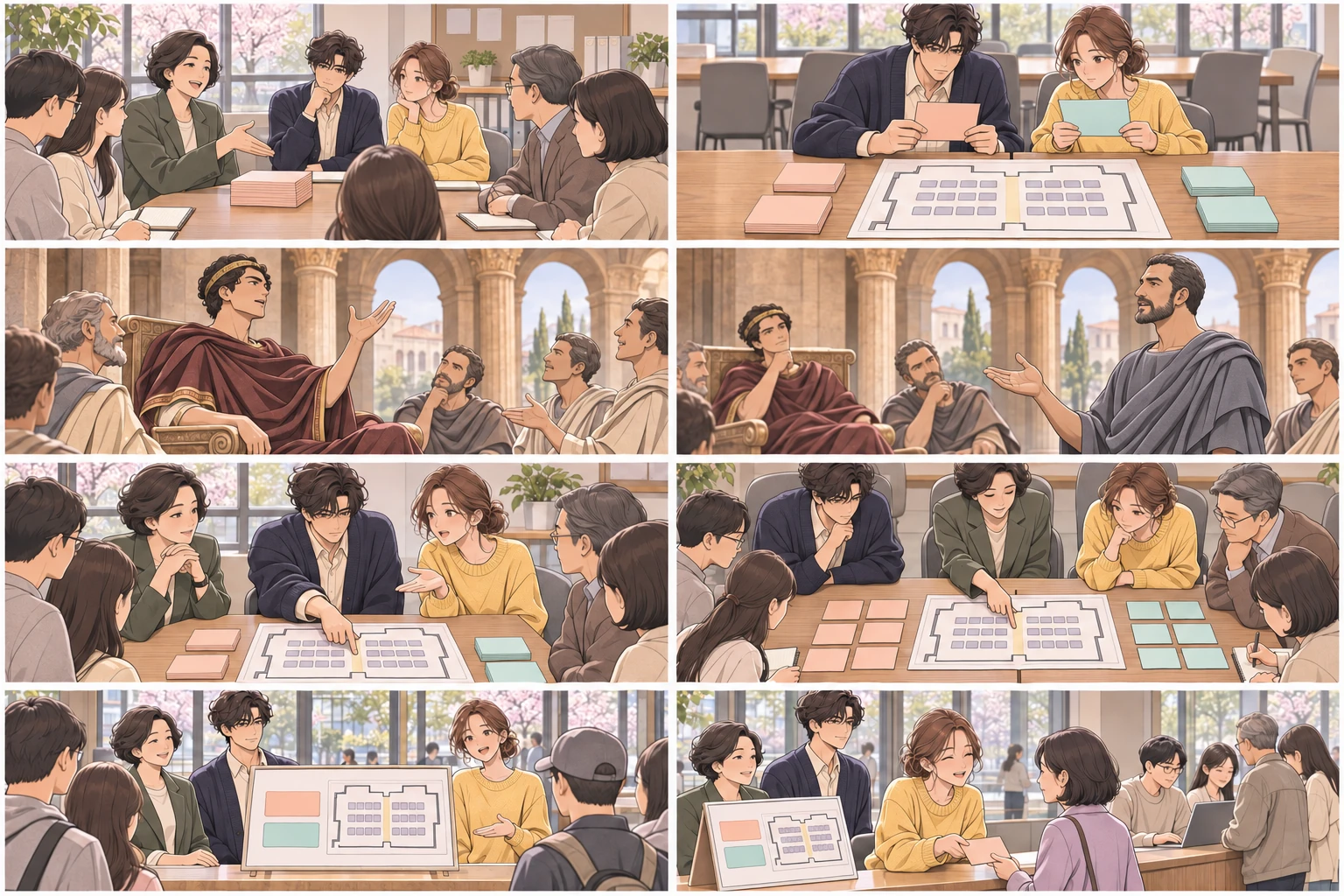
The neighborhood event committee looked at the applications.
One member suggested removing every card without a team name.
02
Story
Jin and Ara looked at an individual application and the floor plan.
The committee was worried about seating and a narrow passage.
03
Story
In an old account, a Roman emperor sought to destroy the Jews.
The officials before him agreed with his proposal.
04
Story
Ketia bar Shalom spoke against it.
He said the world needed the Jewish people just as it needed the winds.
05
Ara
If we leave out everyone without a team, will that fix the seating and the passage?
Jin pointed to the place where the passage narrowed on the plan.
06
Story
The committee tried the same seating rules for individuals and teams.
They checked which arrangements would block the passage separately from who applied.
07
Story
The committee put up a notice saying individuals could apply too.
The same notice showed everyone the seating and passage rules.
08
Story
A person who arrived without a team was helped at the same desk.
Ara looked at the application and the seating plan with them.
A thought from the Talmud
When the emperor sought to destroy the Jews, Ketia bar Shalom objected. Just as the world could not exist without winds, he argued, it could not exist without the Jewish people.
The source idea in our own words · Not a direct quotation
The committee had to work out seating and clear paths. Ara and Jin asked how excluding everyone without a team would solve that problem. The committee reviewed individual applications on the same terms and checked the layout separately. When there’s a specific problem, we can name it before deciding who to leave out.
A modern interpretation for this story
A question to take with you
When someone proposes leaving a whole group out, can I first ask what problem we actually need to solve?
Share the question together with a link to this story.
About the source and this adaptation
In the Babylonian Talmud, Avodah Zarah 10b:12–15, a Roman emperor seeks to destroy the Jews. Ketia bar Shalom objects, invoking the four winds in Zechariah 2:10. The emperor says his argument is right but has him put to death. Ketia leaves his property to Rabbi Akiva and his colleagues. Nedarim 50b:1 briefly mentions the bequest as well. The wisdom line paraphrases Ketia’s objection in sections 12–13. The modern scene about applications for a neighborhood event is fiction created with AI assistance, in a different setting from the ancient anti-Jewish violence.